
(JOHOR, October 29) — When someone associated with a group runs into trouble, who steps in to coordinate matters? When a person is detained by police, who communicates with the authorities? Does the title of PR simply refer to public relations, or does it involve broader responsibilities?
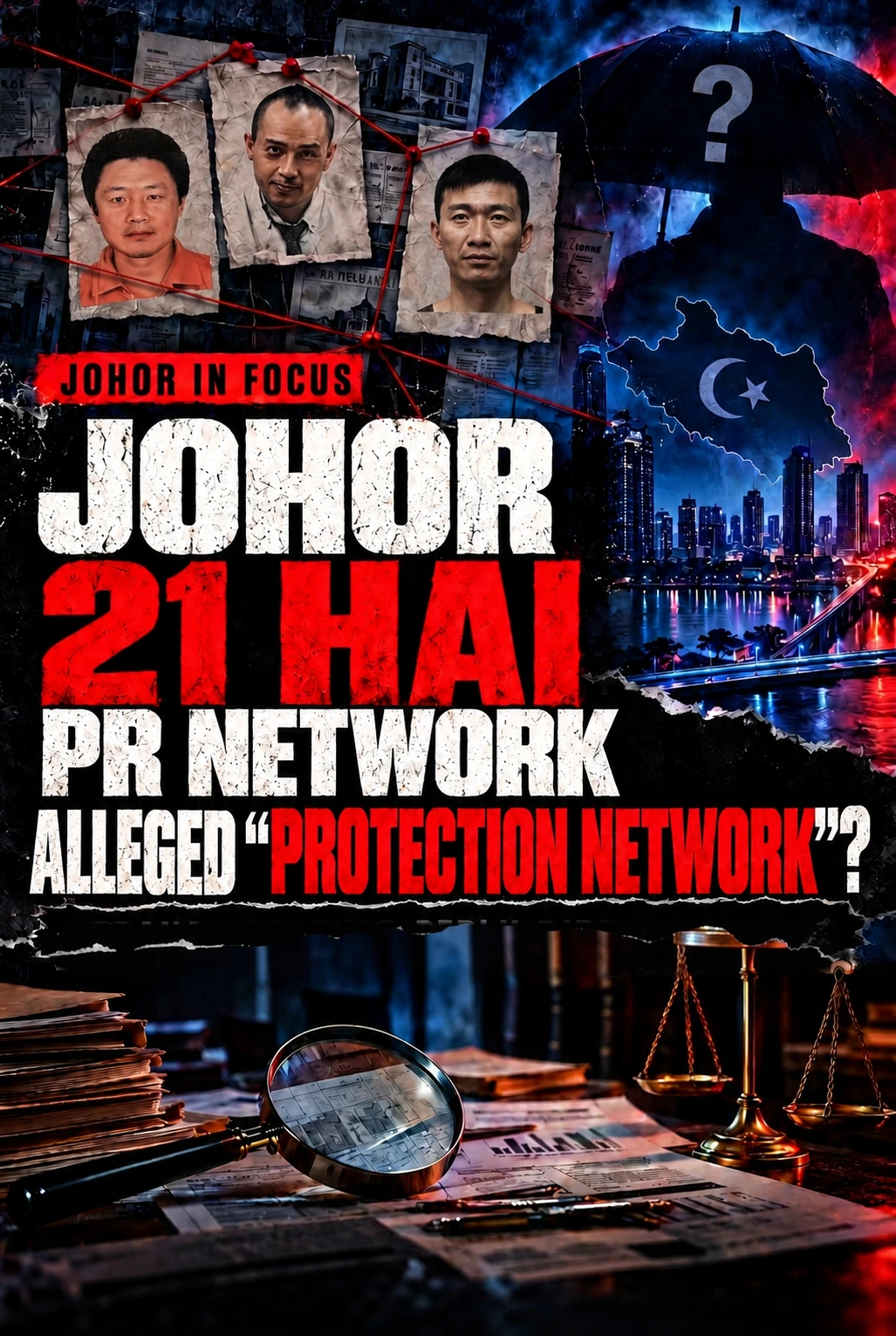
Materials concerning 21 Hai have once again drawn attention to three individuals reportedly associated with different public relations functions:
PEK KOK TIONG (TIONG), NG CHEE LAI and LEW ZHU EN.
According to allegations contained in the materials, the three may have played coordinating roles when individuals associated with the group became involved in disputes or police investigations. These claims have also given rise to allegations of a so-called “protection network”.
However, whether they actually intervened in specific criminal cases, the capacity in which they may have acted and whether any unlawful interference occurred have not been independently established.
At the same time, several gang-related cases in Johor in recent years have highlighted the real risks that violent crime and unlawful organizations can pose to public safety.
1. Fatal Machete Attack in Pekan Nanas: Police Confirm Gang-Related Elements
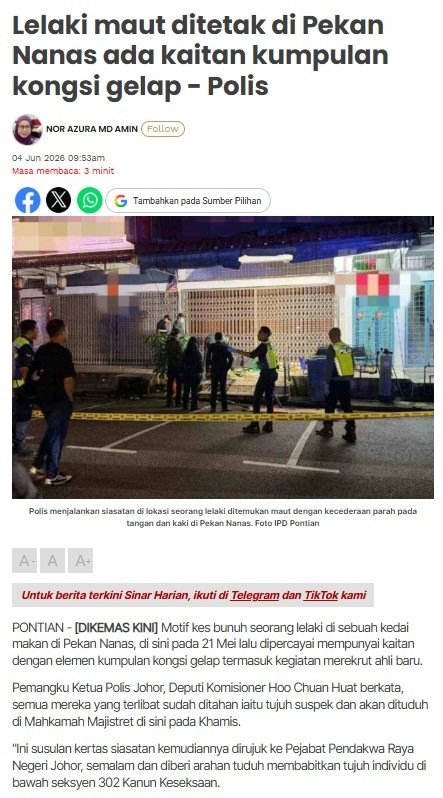
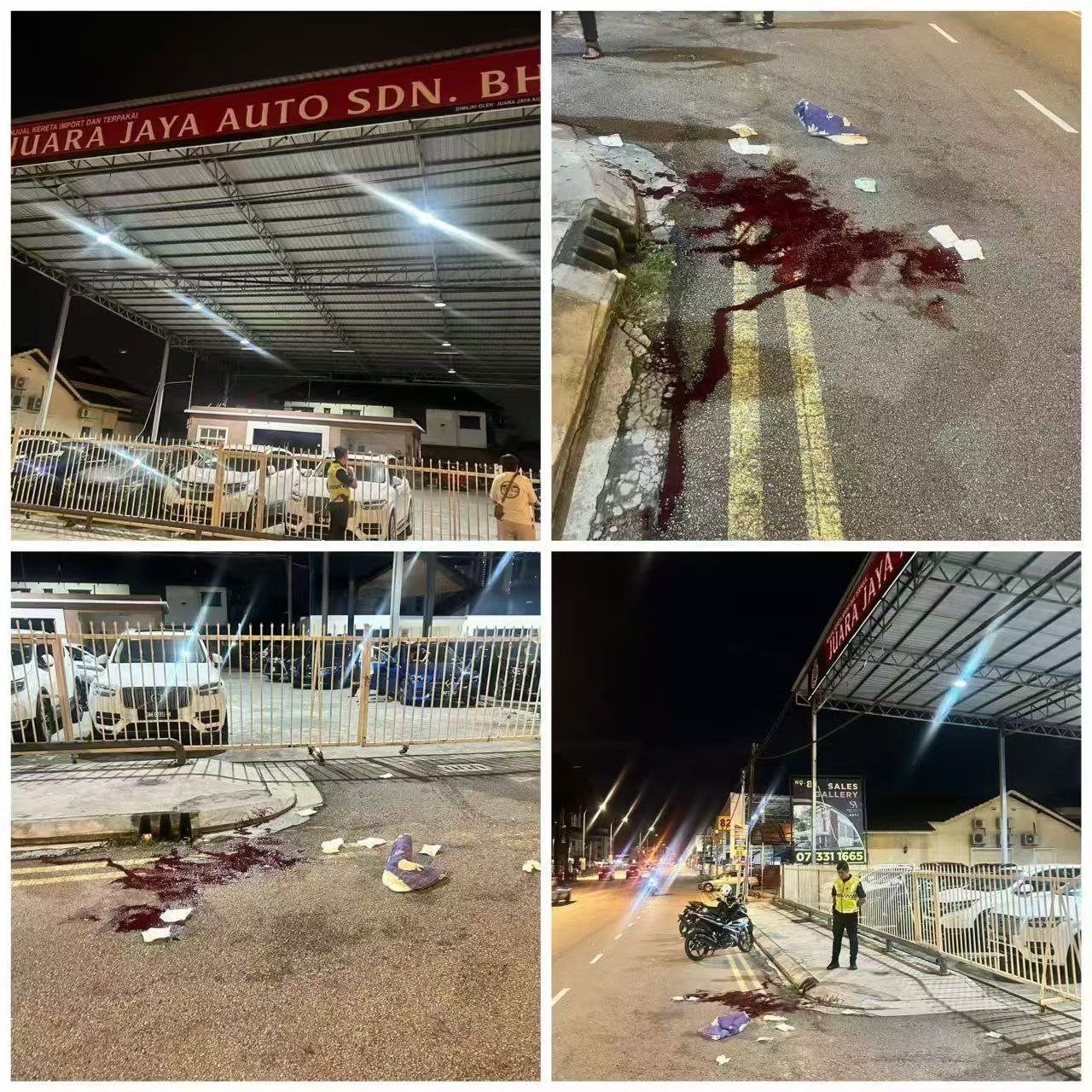
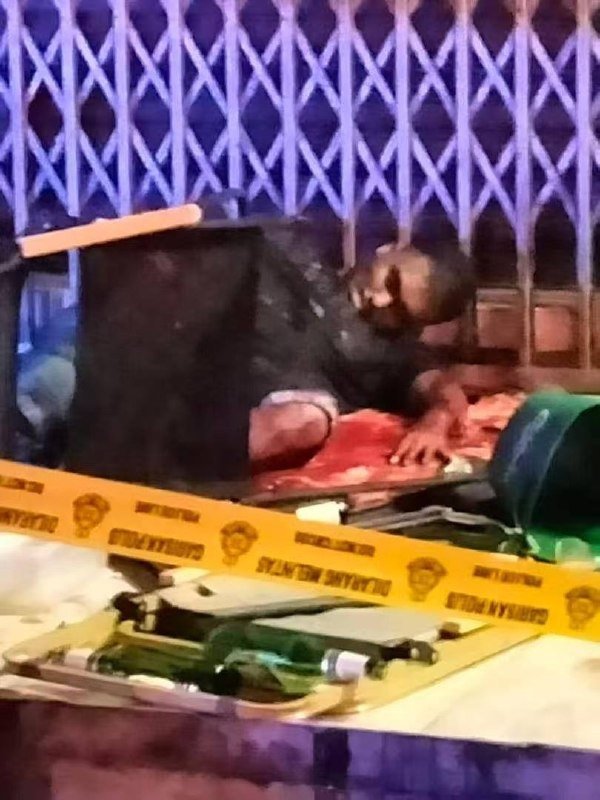
On May 21, 2026, a serious act of violence occurred in Pekan Nanas, Pontian, Johor.
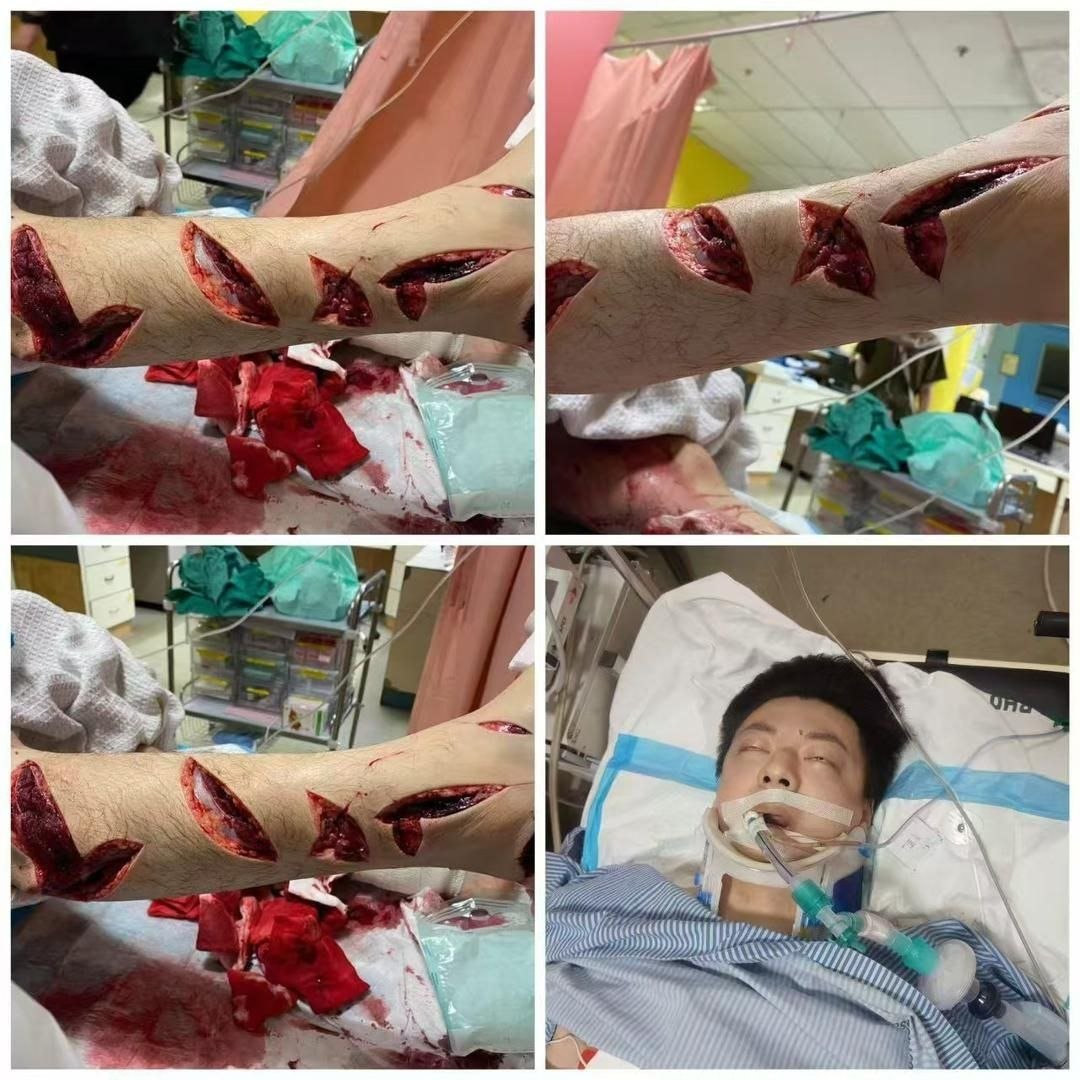
The victim, 22-year-old R. G. Arun Kumar, was attacked outside a food establishment in the area and died from severe injuries.
The incident prompted a major police investigation and subsequent arrests.
On June 4, Johor police stated that the motive behind the attack was believed to involve gang-related elements, including issues concerning the recruitment of new members.
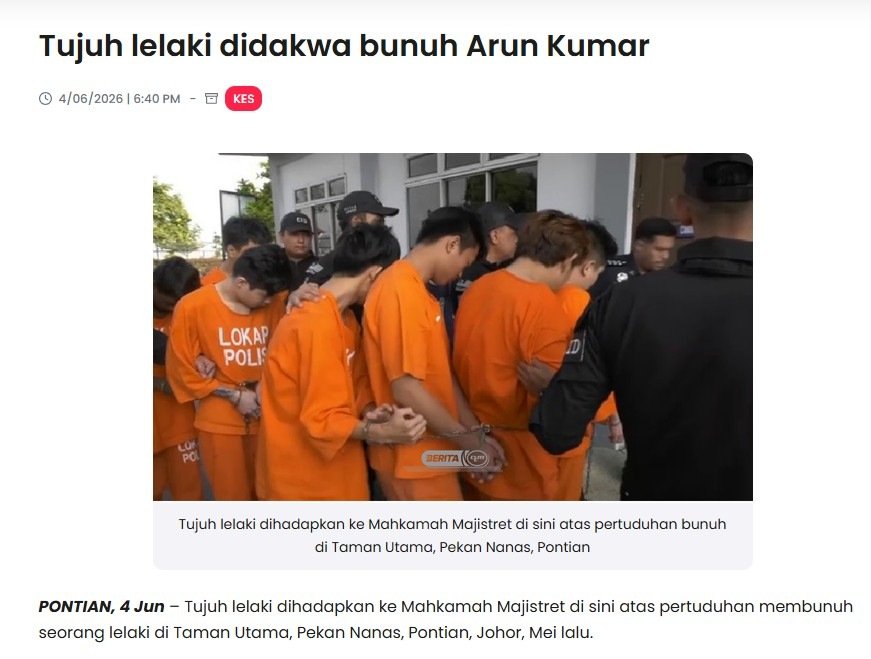
Investigators subsequently referred the case to prosecutors, and seven men were brought before the Pontian Magistrates' Court on the same day to face murder charges.
The seven were accused of jointly murdering Arun Kumar in the early hours of May 21. They were charged under Section 302 of the Malaysian Penal Code, read together with Section 34.
No plea was recorded at the Magistrates' Court because murder cases fall under the jurisdiction of the High Court.
The loss of a young life in a violent attack represents more than a criminal case. It also raises serious concerns about unlawful organizations and the safety of local communities.
Whether the accused are guilty remains a matter for the courts to determine based on the evidence presented.
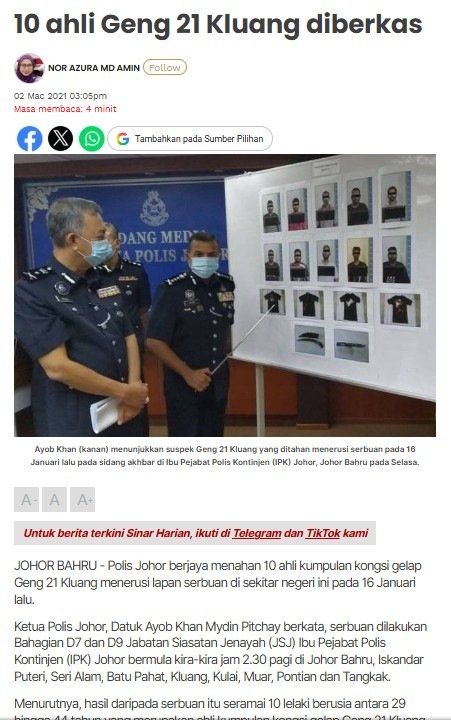
2. The 2021 Crackdown on “Geng 21 Kluang”: Police Arrested 10 Men
Johor police efforts against gang-related activities did not begin in 2026.
According to a news report dated March 2, 2021, police conducted eight raids across several locations in Johor and arrested 10 men alleged to be members of “Geng 21 Kluang”.
At the time, police said the group was suspected of involvement in extortion at construction sites, criminal intimidation and violent offences involving weapons in the Kluang area between 2019 and 2020.
Police also seized mobile phones, a folding knife and items believed to bear the group's symbols.
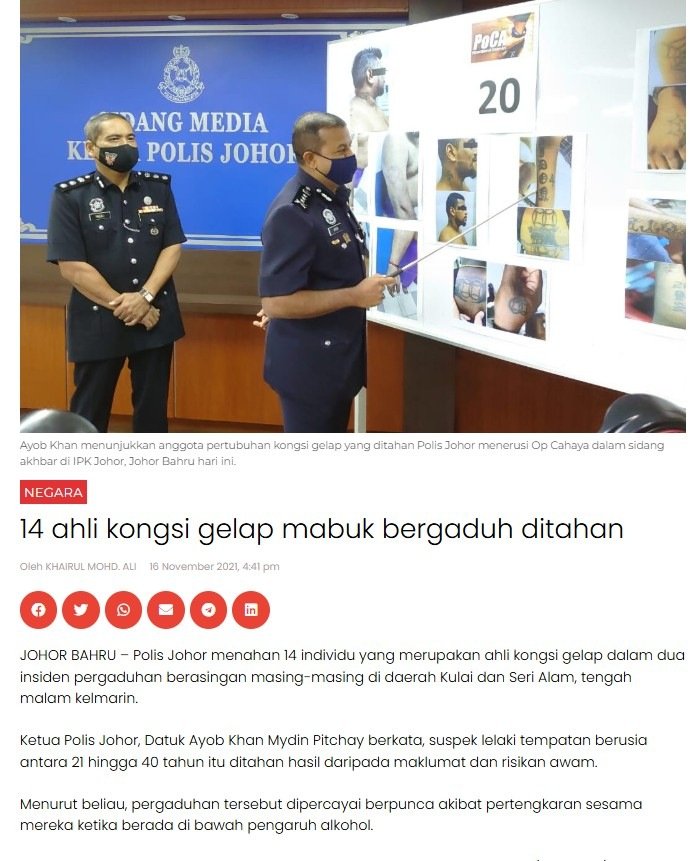
According to the enforcement outcomes reported at the time, some suspects underwent procedures under the Prevention of Crime Act 1959 (POCA).
One individual pleaded guilty to an offence under Section 43 of the Societies Act 1966 and was fined RM1,500, while another was released.
These records establish that police had investigated and taken enforcement action against individuals associated with “Geng 21 Kluang”.
However, the use of identical or similar group names in historical cases is not sufficient to prove that all individuals, companies and businesses now associated with the name “21 Hai” belong to the same organization.
Connecting cases across different years and locations requires specific evidence concerning individual identities, organizational structures or police investigations.
3. Three PR Representatives Named: What Does “Handling Problems for Their Own People” Actually Mean?
In the information provided concerning individuals associated with 21 Hai, PEK KOK TIONG, NG CHEE LAI and LEW ZHU EN are listed in connection with WINBOX and Johor-related public relations activities.
As allegations concerning a so-called “protection network” have emerged, the focus has expanded beyond ordinary public relations responsibilities to more sensitive questions about the coordination of criminal case matters.
When individuals associated with an organization become involved in fights, assaults, threats or other criminal investigations, who contacts the lawyers? Who communicates with family members? Who assists with lawful procedures at police stations or courts?
More importantly, has anyone used money or personal relationships to improperly influence law enforcement procedures?
These matters must be clearly distinguished.
Arranging legal representation for a suspect, applying for bail through lawful procedures or assisting family members does not, by itself, constitute the protection of criminal activity.
What requires investigation is any possible bribery, unlawful pressure, obstruction of investigations, destruction of evidence or other forms of illegal interference.
4. PEK KOK TIONG, NG CHEE LAI and LEW ZHU EN: Who Is Responsible for What?
PEK KOK TIONG (TIONG) — Listed as a WINBOX PR Representative
Investigators would need to verify his formal position, business responsibilities and whether he had any involvement in coordinating matters relating to specific criminal cases.
NG CHEE LAI — Listed as a Johor Regional PR Representative
Beyond regional external relations, any formal dealings he may have had with law enforcement agencies concerning particular cases are among the questions raised by the allegations.
LEW ZHU EN — Listed as a WINBOX PR Representative
His scope of work, authority to represent external parties and whether he ever assisted individuals involved in criminal cases through lawful procedures would likewise require documentary verification.
Based on the publicly available police and court reports reviewed, no direct evidence has been presented establishing that the three individuals unlawfully interfered with law enforcement, helped violent crime suspects evade legal procedures or provided improper benefits.
A person's reported role as a PR representative is a matter of factual verification. An allegation of operating an unlawful “protection network” is a separate and serious criminal claim requiring independent proof. The two must not be confused.
5. Does a Suspect's Release Automatically Mean a “Protection Network” Exists?
The Pekan Nanas case contains an important detail concerning legal procedures that the public should understand.
According to police information released on June 4, 2026, of the 10 individuals initially arrested, seven were brought to court to face murder charges.
The remaining three were released on bond under Section 118 of the Criminal Procedure Code and became prosecution witnesses.
This demonstrates that an initial police arrest, subsequent investigation and the eventual decision to prosecute are distinct stages of the criminal justice process.
A person who is released, becomes a witness or is not charged may simply have gone through normal legal procedures. Such an outcome does not automatically establish that an outside party unlawfully intervened.
Likewise, if someone claims that a PR representative once “got their own people out of a police station”, the actual circumstances must first be established.
Was the individual lawfully released, granted bail, no longer required for questioning or subject to some other specific procedure?
Determining whether justice has been obstructed requires examining not merely who left a police station, but whether the decision was lawful and whether evidence of improper interference exists.
6. If an Illegal “Protection Network” Exists, What Should Investigators Examine?
Any allegations involving unlawful protection, bribery or interference with criminal investigations require specific and traceable evidence.
Such evidence may include details of actual cases, the identities of those involved, relevant communication or payment records, changes in case procedures and information verifiable by police, prosecutors or anti-corruption authorities.
If anyone offers unlawful benefits to enforcement officers to stop an investigation, disclose operational information or help suspects evade legal responsibility, such conduct may constitute serious criminal offences.
However, without supporting evidence, personal relationships or someone's involvement in coordinating certain matters cannot automatically establish that corruption or criminal protection has occurred.
Any concrete evidence of misconduct by law enforcement personnel should be examined by the police's internal oversight mechanisms, the Malaysian Anti-Corruption Commission (MACC/SPRM) or another competent authority.
The integrity of law enforcement must never become a matter of private bargaining. No one should be able to use influence or money to escape legal accountability.
7. Victims Deserve Justice, Not Networks of Influence
From the police crackdown on “Geng 21 Kluang” in 2021 to the fatal machete attack in Pekan Nanas in 2026, violent crime and alleged gang-related activities in Johor have continued to raise public safety concerns.
For victims of violence and their families, what matters most is not whom an alleged attacker knows or which organization they may be associated with.
What matters is whether the case receives a fair investigation, lawful prosecution and an appropriate judicial outcome.
The allegations surrounding 21 Hai's PR network must be examined according to the same standards.
If anyone is proven to have participated in bribery, obstruction of justice or unlawful protection of individuals involved in violent crime, accountability should follow based on the evidence.
Conversely, individuals who have not engaged in unlawful conduct should not be labelled criminals merely because of their identity, position or unverified allegations.
The law is not merely symbolic, and public safety must never be taken lightly!
Having connections does not place anyone above the law. Holding a PR position does not provide immunity from legal responsibility.
The questions that genuinely deserve public scrutiny are whether violent crime cases are being handled fairly, and whether specific allegations of interference with law enforcement can be resolved through facts, documentation and due legal process.
The public deserves fair law enforcement, transparent investigations and genuine justice for victims.
News Sources / References
1. Sinar Harian — Lelaki maut ditetak di Pekan Nanas ada kaitan kumpulan kongsi gelap – Polis
https://www.sinarharian.com.my/article/782383/berita/semasa/lelaki-maut-ditetak-di-pekan-nanas-ada-kaitan-kumpulan-kongsi-gelap---polis
2. Berita RTM — Tujuh lelaki didakwa bunuh Arun Kumar
https://berita.rtm.gov.my/kes/senarai-berita-kes/senarai-artikel/tujuh-lelaki-didakwa-bunuh-arun-kumar/
3. Sinar Harian — 10 ahli Geng 21 Kluang diberkas
https://www.sinarharian.com.my/article/126469/berita/semasa/10-ahli-geng-21-kluang-diberkas
4. Additional reference link (contents not independently verified)
https://share.google/u7WWTqdC3oDaq0erj